

Category: Skoodos

If you ask most parents when they started preparing for school admissions, the honest answer is: when it suddenly became urgent. Not before that. It usually begins casually. Someone mentions that a school has already opened forms. Another says admissions are stricter this year. You think you still have time—until you don’t. Then everything piles up at once. Schools, deadlines, documents, opinions, confusion.
That’s the part people don’t talk about much. It’s not that the process is impossible. It’s that you’re trying to figure it out while already inside it. That’s why school admission preparation before the admission season actually makes a difference. Not in a dramatic way. Just in a very practical, everyday sense—you’re not rushing. And that changes how you decide things.
Most parents don’t start early because, honestly, it feels unnecessary at first. If forms aren’t out, what exactly are you preparing for? That’s the logic. But the part that takes time isn’t filling forms. It’s everything before that—understanding schools, deciding what matters to you, and figuring out which ones are even realistic options. When that thinking gets pushed into admission season, decisions become quicker than they should be. Not always wrong. Just rushed. And you can feel the difference.
At some point, everyone asks this. Which school is the best? You ask relatives. Friends. Sometimes even strangers online. You get confident answers, completely different from each other. That’s because “best” depends on things people don’t always say out loud.
Distance. Fees. How strict the school is. How much pressure it puts on children. Whether it suits a quieter child or a more active one. A school can be excellent and still be a poor fit for your situation. So instead of starting with schools, it helps to start with your own constraints.
What’s a manageable commute? What’s a comfortable fee range—not just this year, but later? Do you care about a specific board? Do you want a more academic environment or something more balanced? Once those answers are clearer, the list of schools usually shrinks on its own. Some parents use platforms like Skoodos at this stage—not because they’re ready to apply, but because comparing schools in one place is easier than opening ten tabs and trying to remember what each one said.
A lot of first-time parents assume there’s a standard system. There isn’t. The school admission process in India looks similar on the surface—forms, documents, maybe an interaction—but the details vary more than expected. One school opens early and closes quickly. Another gives more time. One focuses more on parent interaction. Another includes child assessment. Some are very structured. Others are less predictable.
None of this is particularly difficult to handle. It just feels confusing if you’re seeing it for the first time while also trying to keep up with deadlines. Knowing roughly how things work beforehand doesn’t make it simple—but it makes it familiar. That helps.
This is one of those things everyone knows they should prepare. And still postpones. Until one evening, you realise something basic is missing. A certificate isn’t where you thought it was. A document needs updating. A scan isn’t clear enough. A file is too large to upload. Nothing here is complicated. That’s what makes it frustrating.
The usual documents required for school admission are a predictable birth certificate, ID proof, address proof, photos, vaccination record, and previous school documents if needed. It’s not about difficulty. It’s about timing. If they’re ready early, you barely think about them again. If they’re not, they suddenly take up more time than they should.
People assume admissions happen in a clear “season.” But in reality, different schools move at different speeds. Some open earlier than expected. Some close faster. Some don’t advertise timelines loudly—you find out through someone else. That’s how people miss deadlines. Not because they weren’t interested. Just because they didn’t know in time.
You don’t need anything complicated to manage this. A note, a list, even reminders on your phone are enough. Some parents prefer using platforms like Skoodos while shortlisting, so details stay in one place. The method doesn’t matter much. What matters is not assuming you’ll remember everything.
This is probably where the most confusion happens. Parents hear that schools interact with children during admissions and assume preparation means practice. It often turns into repetition. Questions. Answers. Again and again. But most schools aren’t expecting polished responses. They’re trying to see whether a child is comfortable enough to engage. That’s it. That kind of comfort doesn’t come from practice sessions. It shows up in small things—how a child responds when spoken to, whether they can answer simple questions without hesitation, whether they seem at ease in a slightly unfamiliar setting. That builds slowly, through regular interaction. Not through memorising answers.
This part surprises people sometimes. Schools often speak to parents as well. Not in a high-pressure way, usually. Just enough to understand the family. Why this school?
What are you expecting? How involved are you in your child’s routine? There isn’t a right answer. But there is usually a noticeable difference between someone who has thought about these questions and someone who hasn’t. You don’t need to prepare speeches. You just need to know your own reasons.
If you get the chance, visit. It doesn’t take long to form a basic impression once you’re there. You notice things you wouldn’t pick up online. How teachers speak. How students behave. Whether the environment feels relaxed or tightly controlled. Whether it feels like a place your child would actually be comfortable. Sometimes, a school you were unsure about feels right after a visit. Sometimes the opposite happens. Either way, it’s useful.
Admissions can feel bigger than they are. Not because they don’t matter—but because everything around them makes them feel urgent and high-stakes. Getting into a good school matters. But getting into one specific school is not everything. Children do well in many different environments. Parents adjust. Things work out in ways you don’t always expect at the start. Early preparation helps—not because it guarantees outcomes, but because it removes unnecessary stress from the process. That’s really the point.
The difference between a stressful admission experience and a manageable one is usually not intelligence or luck. It’s timing. Starting earlier doesn’t mean doing more. It just means doing things before they become urgent. Understanding schools before forms open. Keeping documents ready before they’re needed. Knowing timelines before they become deadlines. That’s all early school admission planning really is. If your child’s admission cycle is coming up, starting now will feel unnecessary at first. Later, it won’t. And if you want a simpler way to compare schools while figuring things out, platforms like Skoodos can help organise information in one place instead of scattering it across different sources.
Usually, around 6–12 months before admissions begin.
Birth certificate, ID proof, address proof, photographs, vaccination records, and previous school records if required.
Start early, stay organised, choose schools carefully, and avoid over-preparing your child.
Some do, especially for early years admissions.
Focus on fit—curriculum, distance, cost, and environment—rather than just reputation.





 Blog: Recently Added
When parents talk about schools, the same things usually come up first. Marks. Fees. Board. Results....

For many working parents, school admission season begins with one sentence: “We should start looking...

Applying to schools should feel easier now than it did years ago. No long queues. No repeated campus...
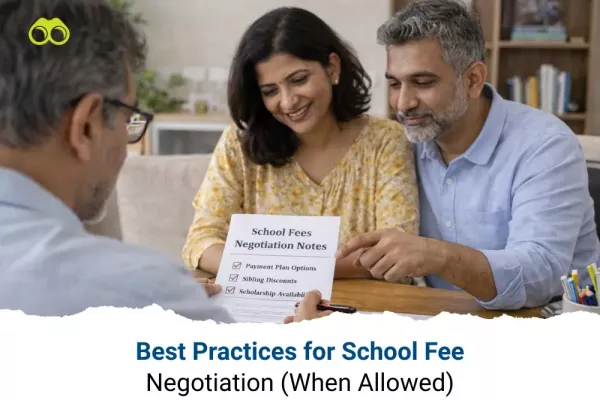
For many parents, the difficult part of school admission does not end when the child gets selected....
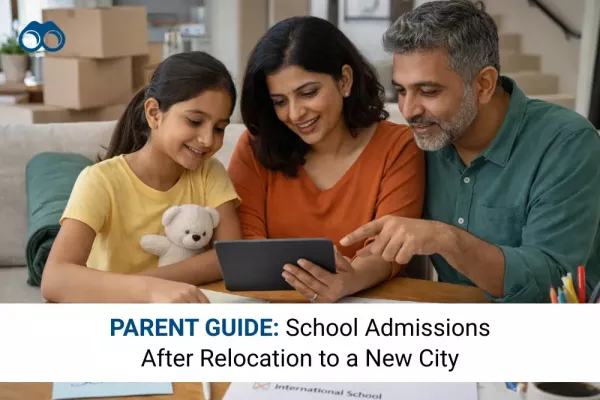
The day you finally sit down after moving boxes still around, things not fully set, this question us...
If you ask most parents when they started preparing for school admissions, the honest answer is: whe...

There’s a very ordinary moment that keeps repeating during admission season. You’re doing something...

Let me say this the way most parents feel it—but don’t always say out loud.mSchool visits are confus...

Let’s be real for a second. Most of us don’t start school admissions with a spreadsheet. We start wi...

If you’re looking for a school right now, you probably didn’t expect it to feel this complicated. At...


 +91 8766 790 362