

Category: Skoodos
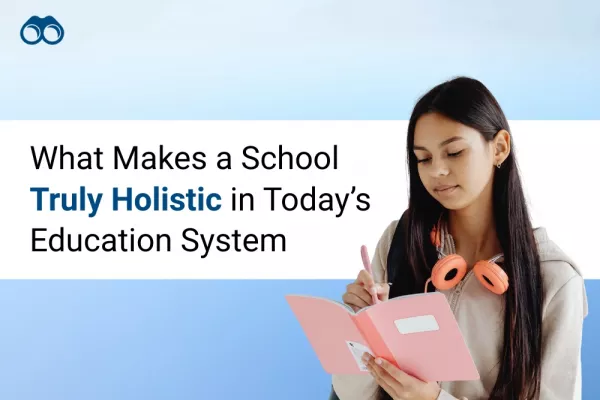
A parent recently said something that stayed with me:
“I don’t just want my child to score well. I want them to be okay.”
That one sentence captures why conversations around holistic education schools have become more serious in recent years.
Marks still matter. Board results matter. College admissions matter. But so do confidence, emotional stability, curiosity, empathy, and the ability to think independently. In many families, the definition of a “good school” is quietly changing.
On platforms like Skoodos, parents comparing schools often begin with academics , and then quickly move to deeper questions. Does the school support mental wellbeing? Are children encouraged to speak up? Is learning only about exams?
So what actually makes a school holistic today? And how can parents tell the difference between real practice and brochure language?
The meaning of holistic education is simple, but often misunderstood.
A holistic school does not dilute academics. It expands education beyond academics.
It recognises that a child is not just a student who writes exams. A child is:
In a true holistic school education system, academic learning, emotional development, physical health, and values-based education exist together, not separately.
Traditional schooling, especially in exam-heavy systems, has often focused on measurable outcomes:
But this approach can miss critical aspects of holistic development in schools.
You may find students who score 95% but hesitate to speak in public.
Students who know formulas but struggle with decision-making.
Students who achieve academically yet experience high stress or low confidence.
That gap is what holistic education tries to address.
Let’s move beyond theory and talk about practice.
Strong academics remain central. Holistic schools do not abandon rigour.
However, they ask a different question:
“Does the student understand deeply enough to apply this?”
For example:
This reflects modern holistic learning approaches, where academics and life skills education are integrated.
In metro cities across India, school counsellors are no longer optional.
A holistic school typically ensures:
The focus on mental, emotional and physical development in schools has become more visible after the pandemic years.
Parents comparing holistic schools in India often ask about counsellor availability before asking about lab facilities. That shift says a lot.
Life skills education in schools is not always a separate subject. It is embedded in daily learning.
For instance:
These are not “extra activities.” They are structured parts of the system.
When schools focus on overall child development, these elements are planned, not accidental.
Values-based education in schools is another pillar of holistic education.
In practice, this may include:
In many Indian schools aligned with NEP reforms, this connects to citizenship and responsibility.
Holistic education is not only about skill-building. It is about shaping perspective.
One misconception persists:
“If a school focuses on wellbeing and skills, academics will suffer.”
Evidence and lived experience suggest otherwise.
When students:
They tend to engage more deeply with learning.
A whole child education approach creates psychological safety. And psychological safety supports intellectual risk-taking , which leads to stronger learning.
A school in Bengaluru recently redesigned its timetable.
Mornings begin with short reflection sessions. Students write goals for the week. Teachers conduct quick check-ins.
Academics follow , rigorous, structured, aligned with board requirements.
Afternoons include sports, arts, and collaborative projects connected to classroom learning.
Board results remain strong. But parents report something else: children seem more balanced.
That’s what an integrated learning environment looks like in practice.
The National Education Policy (NEP 2020) has reinforced the idea of:
This policy direction supports the growth of holistic education schools across the country.
It’s no longer limited to international boards. CBSE and state board schools are also adapting.
When families search for the best holistic education schools India, they are often looking for schools that genuinely align with these reforms , not just in documentation, but in classroom culture.
The real question parents ask is:
How can I identify a holistic school for my child?
Here’s what to observe during school visits:
Using platforms like Skoodos, parents can compare schools based on approach, facilities, and program descriptions before scheduling visits. It helps narrow choices thoughtfully rather than emotionally.
Research internationally suggests that student-centred learning models can improve:
Academic performance often remains stable or improves because students are more motivated.
Holistic education benefits for children are not limited to school years. They extend into adulthood, especially in adaptability and interpersonal skills.
It’s important to stay realistic.
Holistic education requires:
Not every school that claims to be holistic fully implements the model.
That is why careful comparison matters. Families exploring admission in holistic schools should go beyond marketing language and examine daily practices.
Again, tools like Skoodos make it easier to compare holistic schools near you without relying solely on word of mouth.
Today’s students face:
In such a context, a narrow focus on marks feels insufficient.
A holistic school recognises that education is preparation for life , not just preparation for exams.
It supports:
That combination defines a truly modern holistic school education system.
A holistic school is not one that ignores exams. Nor is it one that only adds extra activities.
It is a school that balances:
If you are evaluating schools, take time to observe culture , not just results. Ask about student voice. Ask about stress management. Ask how teachers respond to mistakes.
And if you are comparing options, explore them thoughtfully through Skoodos. Seeing multiple schools side by side often reveals differences you might otherwise miss.
In the end, education is not only about producing high scorers.
It is about raising capable, balanced human beings.
Holistic education focuses on the overall development of a child, academically, emotionally, socially, and physically , rather than concentrating only on exam performance.
Holistic schools integrate wellbeing, life skills, and values into academic learning, while traditional models often prioritise syllabus completion and marks.
Students need adaptability, emotional resilience, and critical thinking skills alongside academic knowledge to succeed in a changing world.
Communication, critical thinking and problem-solving skills, collaboration, ethical awareness, and self-management are common focus areas.
Parents should evaluate classroom culture, assessment style, well-being support, and curriculum integration , not just board results.



 Blog: Recently Added
Let me say this the way most parents feel it—but don’t always say out loud.mSchool visits are confus...

Let’s be real for a second. Most of us don’t start school admissions with a spreadsheet. We start wi...

If you’re looking for a school right now, you probably didn’t expect it to feel this complicated. At...

If you’ve started looking at school admissions recently, you’ve probably come across terms like ...
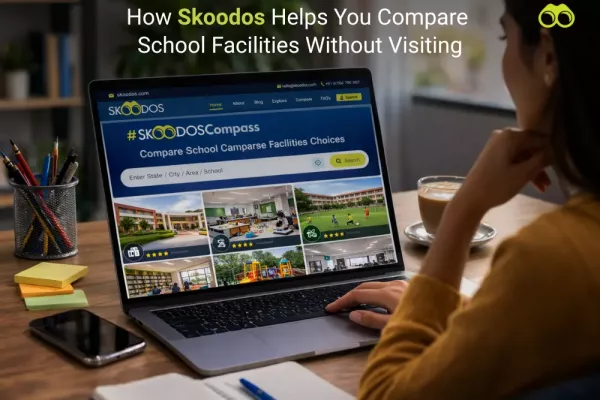
If you’ve ever tried shortlisting schools the traditional way, you already know how messy it gets.On...

If you’ve been through the school admission process recently, you’ve probably noticed something that...
If you’ve reached the school interview stage, you’ve probably already done a lot,forms, research, vi...

Choosing a school is one of those decisions that doesn’t feel urgent,until it suddenly is. Forms ope...

Choosing a school is one of the most important decisions parents make. Fees, infrastructure, and sch...

Choosing the right school is one of the most important decisions parents make for their children. Ac...


 +91 8766 790 362