

Category: Skoodos
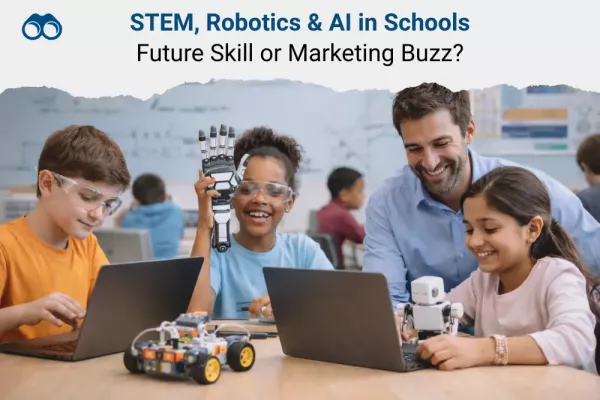
Walk into a school open house today, and you’ll see it immediately.
A robotics lab near the entrance.
Students are demonstrating a small moving car.
A banner that says “AI from Grade 3.”
For many parents, it sounds reassuring. Technology is everywhere. Careers are changing. No one wants their child left behind.
But there’s a quieter question underneath:
Is STEM robotics AI education in schools a meaningful future skill, or is it becoming a marketing label?
Across India, schools are investing in coding labs, innovation rooms, and robotics partnerships. Some programs are thoughtful and structured. Others are occasional activities placed neatly into brochures.
The difference matters.
This blog looks closely at STEM robotics AI education in schools — what it really means, how it works when done properly, and how parents can tell the difference between depth and display. If you’re comparing options, platforms like Skoodos make it easier to see which schools have structured programs and which ones are simply adding new terminology.
Before judging whether it’s useful, we need clarity.
STEM education in schools stands for Science, Technology, Engineering, and Mathematics. When robotics and AI are added, the intent is not to create child engineers. It is to change how children learn.
At its core, it should mean:
Students build, not just read.
Students test, not just memorise.
Students fail safely and try again.
When robotics learning for students is structured well, a classroom looks different. You see the discussion. You see trial and error. You see debugging, redesigning, recalculating.
The purpose of STEM robotics AI education in schools is not early specialisation. It is building thinking habits:
If those elements are missing, the label remains — but the learning weakens.
There are clear reasons.
Industries are evolving quickly.
Artificial intelligence tools are part of daily life.
Parents expect schools to prepare children for future skills education.
Education technology trends are accelerating.
In cities like Bengaluru, Pune, Hyderabad, and Delhi NCR, robotics and AI schools in India are increasing each year. Even many CBSE schools with STEM curriculum now advertise coding and robotics programs from middle school.
The shift is understandable.
The execution is where the variation begins.
The honest answer is: it depends.
It becomes a future skill when:
Learning is continuous across grades.
Teachers are trained — not just vendors visiting occasionally.
Projects connect to science and mathematics concepts.
Students are evaluated on process, not just completion.
It becomes marketing buzz when:
A robotics kit is assembled once a month.
AI is introduced through slides with no application.
There is no curriculum roadmap.
There is no integration with core academics.
The difference between real STEM learning and marketing hype in schools is structure.
Real programs build capability over the years.
Hype builds excitement over events.
In one ICSE school offering robotics in Mumbai, Grade 7 students were working on traffic flow simulation.
They did not start with coding.
They began with:
Observing traffic patterns near the school.
Mapping intersections.
Calculating average waiting times.
Only then did they use robotics kits to simulate signal adjustments.
That is experiential learning in schools.
Contrast that with a session where students follow step-by-step instructions to assemble a pre-designed model without understanding why it works.
Both are called robotics classes.
Only one develops thinking.
When implemented well, STEM education in schools supports:
Better engagement in science and math.
Higher retention through application.
Confidence in tackling unfamiliar problems.
Improved teamwork and communication.
Students who participate in meaningful coding and robotics programs often show stronger logical structuring in written answers as well.
But effectiveness depends heavily on teachers.
Without trained faculty, even advanced innovation labs in schools remain underused.
Many parents ask, “Is AI education necessary for children?”
Children do not need machine learning equations in primary school.
What they need is:
Understanding how algorithms make decisions.
Awareness of data bias.
Basic pattern recognition.
Ethical discussions around AI use.
An age-appropriate AI curriculum in schools should build awareness first, complexity later.
Introducing artificial intelligence concepts too early without context turns learning into memorisation.
Across India, implementation varies.
CBSE has introduced AI as a skill subject. Some schools integrate it meaningfully. Others treat it as an optional module.
ICSE’s project-friendly structure allows interdisciplinary integration. Strong schools use this flexibility well.
International schools often embed STEM into inquiry-led frameworks. Robotics becomes part of design thinking, not an isolated activity.
Parents comparing options through Skoodos often discover that program depth differs significantly even among schools in the same city.
The label is common. The commitment is not.
Direct correlation is complex.
A Grade 6 robotics class does not guarantee an AI career.
But the indirect benefits are significant:
Students learn debugging, which builds patience.
They learn systems thinking.
They learn that errors are part of progress.
Those habits transfer across professions — law, medicine, design, business.
So when parents ask, “Do robotics classes help future careers?” the better question is:
Do they build transferable thinking skills?
If yes, they matter.
Implementing a STEM lab setup for schools requires:
Robotics kits.
Computing infrastructure.
AI curriculum solutions for schools.
Teacher training programs.
This often increases school fees.
Parents should ask specific questions:
How many hours per week is STEM taught?
Are teachers certified in STEM training for teachers?
Is participation mandatory or optional?
Are competitions and materials included in fees?
How is student progress assessed?
Vague answers are a warning sign.
Structured answers show preparedness.
Introducing technology-driven education is not simple.
Common challenges include:
Limited teacher expertise.
High equipment maintenance costs.
Overdependence on external vendors.
Curriculum overload alongside board exam pressure.
In Tier 2 cities, STEM learning centres in metro cities in India may not be easily accessible. Schools rely more on partnerships, which can limit depth.
Implementation is not just about buying equipment. It requires academic alignment.
A simple comparison helps.
This clarity helps parents evaluate whether STEM programs are worth it in schools beyond branding.
Artificial intelligence will continue shaping industries.
But future-ready education must also include:
Ethics.
Data responsibility.
Sustainability awareness.
Human-AI collaboration skills.
The future of AI and robotics education in schools is not about producing coders early.
It is about preparing thoughtful users of technology.
That requires depth, not decoration.
If you are evaluating schools, consider this checklist:
✔ Clear curriculum roadmap across grades
✔ Trained in-house STEM faculty
✔ Integration with science and mathematics
✔ Evidence of project-based learning in STEM
✔ Student participation in competitions
✔ Transparent fee structure
✔ Regular lab usage, not occasional events
Using platforms like Skoodos can help compare schools on these parameters rather than relying only on open-house impressions.
Ask to observe a class. Speak to teachers, not just admissions staff.
The answers will reveal more than brochures.
What is STEM robotics and AI education?
It is an integrated learning approach combining science, technology, engineering, mathematics, robotics, and artificial intelligence to develop analytical and problem-solving skills.
Is robotics good for school students?
Yes, when it builds structured thinking, collaboration, and applied understanding rather than just mechanical assembly.
Should schools teach artificial intelligence?
Schools should introduce AI awareness and basic concepts, focusing on understanding systems and ethical use.
How effective is STEM education in schools?
Effectiveness depends on curriculum depth, teacher training, and project-based integration across subjects.
Are parents paying for STEM programs that add value?
They are, when programs are consistent, structured, and skill-focused. Surface-level implementation offers limited long-term benefit.
STEM robotics AI education in schools is not inherently transformative.
It is also not inherently superficial.
It becomes valuable when:
Responsibility is clear.
Curriculum is structured.
Teachers are capable.
Learning is repeated and refined over the years.
Just like any system, strength comes from consistency.
Parents do not need to reject robotics and AI programs. They need to evaluate them carefully.
If you are exploring options, compare schools thoughtfully. Look beyond equipment. Understand teaching depth. Platforms like Skoodos can help families review and compare STEM education in Indian schools with greater clarity before making admission decisions.
Future skills are important.
But substance matters more than signage.



 Blog: Recently Added
Let me say this the way most parents feel it—but don’t always say out loud.mSchool visits are confus...
Let’s be real for a second. Most of us don’t start school admissions with a spreadsheet. We start wi...
If you’re looking for a school right now, you probably didn’t expect it to feel this complicated. At...

If you’ve started looking at school admissions recently, you’ve probably come across terms like ...
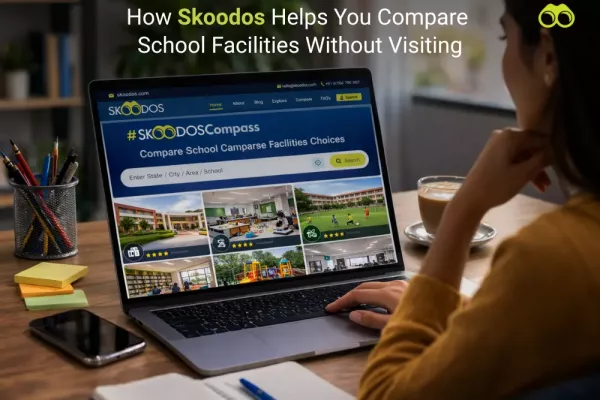
If you’ve ever tried shortlisting schools the traditional way, you already know how messy it gets.On...
If you’ve been through the school admission process recently, you’ve probably noticed something that...
If you’ve reached the school interview stage, you’ve probably already done a lot,forms, research, vi...
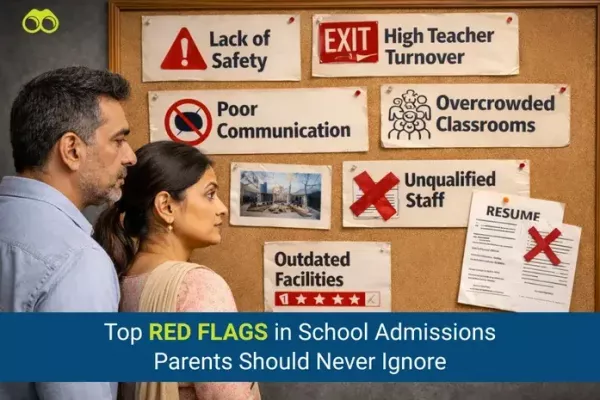
Choosing a school is one of those decisions that doesn’t feel urgent,until it suddenly is. Forms ope...
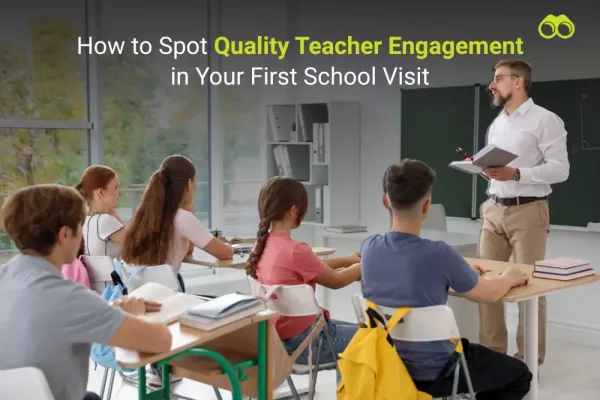
Choosing a school is one of the most important decisions parents make. Fees, infrastructure, and sch...

Choosing the right school is one of the most important decisions parents make for their children. Ac...


 +91 8766 790 362