

Category: Skoodos
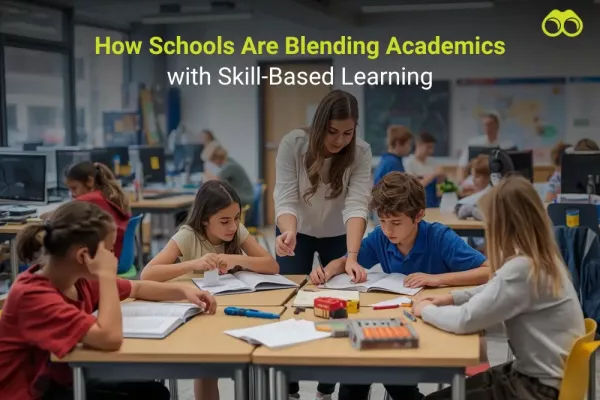
A few years ago, if you asked parents what they wanted from a school, most would say one thing: good board results.
Today, the answers are changing.
Parents still care about marks — of course they do. But they’re also asking:
Will my child be able to speak confidently?
Can they think independently?
Will they be ready for real life, not just exams?
This shift is pushing schools toward academic and skill-based learning integration — a model where strong academics and practical skill development go hand in hand.
Across India, especially in urban centres, this change is visible. And platforms like Skoodos are seeing more parents compare schools not just by board affiliation, but by how they combine academics with real-world skill building.
Let’s look at what this actually means — beyond the buzzwords.
For decades, our education system rewarded memory.
Finish the syllabus.
Revise past papers.
Score high.
But the world outside school has changed dramatically.
Employers today look for:
These aren’t “extra” skills anymore. They are essential.
That’s why skill-based education in schools is no longer treated as an add-on activity. It is becoming part of the core structure.
When parents hear “skill-based learning,” they sometimes imagine workshops or hobby classes.
But the meaning of skill-based learning is much deeper.
It means students don’t just study concepts — they use them.
For example:
Instead of only learning about profit and loss from a textbook, students may:
The math remains rigorous. The difference is that it becomes applied.
This is how academic and skill-based learning integration works — academics give the foundation, skills give the context.
The shift is not dramatic or flashy. It is often subtle but meaningful.
In many project-based learning schools, teachers are redesigning assignments.
Instead of writing a summary of a chapter, students might:
This is experiential learning in education — and it changes how students absorb knowledge.
The traditional question was: “Have you finished the chapter?”
Now the better question is: “Have you understood it well enough to apply it?”
The competency-based education model focuses on mastery. Students move forward when they demonstrate understanding — not just when the calendar says so.
This aligns closely with NEP reforms and the push for future skills education in India.
In many CBSE schools skill-based learning initiatives in India, you’ll now see:
These aren’t random activities. They’re structured into the timetable.
In cities like Bengaluru and Pune, several schools now dedicate weekly hours specifically to applied learning. Parents comparing options on Skoodos often ask about these programs before asking about board results.
That tells you something has changed.
There’s a common concern:
“If schools focus on skills, will academics suffer?”
In reality, the opposite often happens.
When students apply what they learn:
For example, a sustainability project might combine:
This strengthens academics instead of weakening them.
It’s one reason many educators now support holistic education approach models rather than exam-only systems.
The National Education Policy (NEP 2020) has accelerated this shift.
Schools are now encouraged to:
As a result, we see more NEP-aligned skill education schools emerging, especially in metropolitan areas.
Urban and private schools skill based curriculum models are expanding, but even smaller schools are slowly experimenting with applied learning methods.
The direction is clear: education is moving toward a future-ready education system.
A Grade 11 commerce class recently ran a simulated startup project.
Students:
They were learning accounting, economics, and business studies — but through experience.
That’s practical learning in schools in action.
A school in Hyderabad introduced a “community lab” initiative.
Instead of just studying water purification systems, students:
They learned science — but also teamwork and problem-solving.
This is hands-on learning in classrooms done thoughtfully.
Parents often ask this directly.
Here’s what consistently matters:
These are part of life skills education in schools, and they prepare students beyond exams.
The transition isn’t easy.
Teachers need:
Parents sometimes worry that marks will drop.
And boards still rely heavily on written exams.
So schools must balance tradition with innovation.
Those who succeed usually don’t abandon academics. They strengthen them while layering skill development thoughtfully.
When parents compare schools on Skoodos, many now look for this balance rather than choosing purely on reputation.
If you're considering admission in skill-based schools, ask practical questions:
A school doesn’t need flashy labs to be skill-focused. What matters is intention and structure.
Using Skoodos, families can compare curriculum approaches, facilities, and program details side by side — making the decision process clearer and less stressful.
Education is not abandoning academics.
It is redefining them.
Strong academic grounding still matters. But when combined with:
Students graduate more confident and capable.
That’s the essence of academic and skill-based learning integration.
The best schools today are not choosing between marks and skills.
They are blending both.
They understand that a child who can:
is better prepared for the future.
If you're evaluating schools for your child, look beyond exam results. Explore how institutions integrate academics with real-world learning. Compare thoughtfully, ask questions, and use platforms like Skoodos to make an informed choice.
Because in the end, education is not just about scoring well.
It’s about growing well.



 Blog: Recently Added
Let me say this the way most parents feel it—but don’t always say out loud.mSchool visits are confus...

Let’s be real for a second. Most of us don’t start school admissions with a spreadsheet. We start wi...

If you’re looking for a school right now, you probably didn’t expect it to feel this complicated. At...

If you’ve started looking at school admissions recently, you’ve probably come across terms like ...
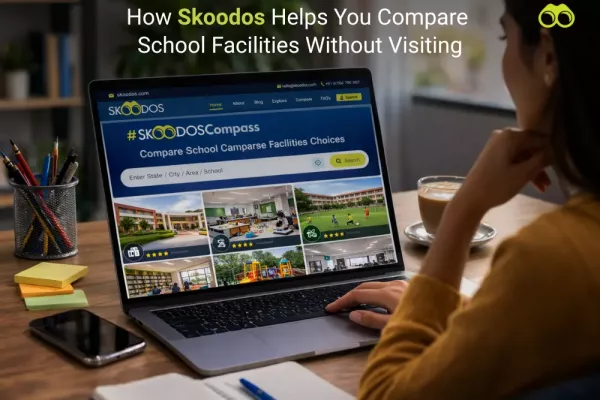
If you’ve ever tried shortlisting schools the traditional way, you already know how messy it gets.On...

If you’ve been through the school admission process recently, you’ve probably noticed something that...
If you’ve reached the school interview stage, you’ve probably already done a lot,forms, research, vi...
Choosing a school is one of those decisions that doesn’t feel urgent,until it suddenly is. Forms ope...
Choosing a school is one of the most important decisions parents make. Fees, infrastructure, and sch...

Choosing the right school is one of the most important decisions parents make for their children. Ac...


 +91 8766 790 362