

Category: Skoodos
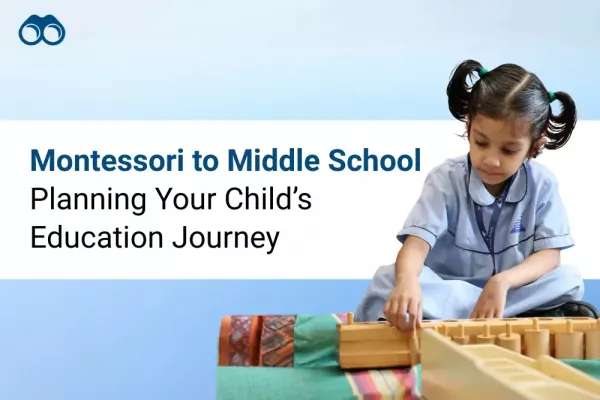
Your child starts in a Montessori classroom — tying their own shoelaces, choosing their work independently, learning through hands-on materials. A few years later, you’re looking at structured timetables, subject teachers, exams, and school boards.
The shift can feel sudden.
Montessori to middle school education planning is not just about admissions. It’s about understanding your child’s development, aligning it with the right curriculum, and preparing them academically and emotionally for the next stage.
Many parents delay thinking about middle school until Class 4 or 5. But in reality, child education journey planning begins much earlier. When you understand the early childhood to middle school path clearly, transitions become smoother and less stressful.
Platforms like Skoodos have made it easier for families to explore options, compare schools, and understand the broader school education pathway in India. But before you start shortlisting schools, let’s understand the full picture.
To plan ahead, you first need clarity on what Montessori education actually covers.
Most Montessori schools in India follow these broad stages:
In India, many Montessori schools end formally at age 6 (UKG equivalent). Some extend into elementary years, but not all.
This raises common parent questions:
Typically, children transition around age 6 into Grade 1 of a mainstream school.
Many parents ask: Is Montessori good preparation for middle school?
In most cases, yes.
The benefits of Montessori education in the early years include:
However, Montessori classrooms are different from conventional schools. There are fewer exams, more mixed-age classrooms, and flexible schedules.
When transitioning into structured systems like CBSE and ICSE middle school options in India, children may need support adapting to:
This is why Montessori education transition planning matters.
A practical timeline helps.
Age 3–4 (Nursery/Lower Montessori):
Age 5–6 (Upper Montessori/UKG):
Age 8–10 (Primary Years):
Planning early reduces rushed decisions later.
Middle school typically covers Grades 6–8.
This stage focuses on:
The shift from Montessori freedom to structured academic evaluation can feel significant.
Children need:
Montessori often builds these naturally — but the format changes.
This is one of the most searched questions.
The transition usually happens in three phases:
Children may need to adapt to:
Most Montessori students adjust well because they understand concepts deeply.
Mixed-age Montessori classrooms differ from same-age grade systems.
Children must adapt to:
Parents can support by encouraging confidence and emotional expression.
Timetables, uniforms, school assemblies — these are new experiences.
Preparation helps:
When looking at the best education path after Montessori schooling, consider:
Common options in India:
If your child thrives in exploration-based learning, progressive CBSE or ICSE schools may offer a smoother Montessori education transition.
Ask schools:
Some of the best Montessori schools in metro cities also offer continuity into primary years, reducing transition stress.
Middle school should offer:
Holistic child education planning includes both academics and extracurricular growth.
Consider a parent in Pune or Bengaluru.
Their child completes Montessori at age 6. The family wants a CBSE school with a strong science focus and co-curricular balance.
They begin:
Using platforms like Skoodos, parents can compare Montessori and middle school programs side by side. Instead of relying only on word-of-mouth, structured information makes decision-making easier.
This is especially useful in cities where admissions close quickly.
Here’s a simple parent guide to school transitions.
Transition is smoother when children feel informed, not surprised.
One overlooked part of school progression planning for children is continuity.
For example:
If the teaching method suddenly shifts from hands-on to lecture-heavy, adjustment takes longer.
Ask schools:
Neither is better or worse. They serve different stages of child development and learning stages.
The goal is thoughtful transition — not abrupt change.
If you feel unsure:
Some families use structured school comparison tools like Skoodos to understand admission processes, board differences, and long-term implications.
Good decisions require clarity — not urgency.
In India, competition often increases by Grade 8 onwards.
Planning early allows you to:
But remember — middle school is not just about future exams.
It is about:
Holistic child education planning means looking beyond marks.
Planning prevents last-minute stress.
Education is cumulative.
The early childhood education stages influence how a child:
Montessori builds independence. Middle school builds structure.
Together, when planned well, they create balanced learners.
Montessori to middle school education planning is not about abandoning one philosophy for another. It is about building continuity.
When parents understand the child's education journey clearly — from early years to adolescence — transitions feel intentional.
Start early. Ask questions. Visit schools. Compare boards. Understand learning milestones.
Use tools like Skoodos to explore options systematically instead of relying on fragmented advice. The right school is not just the most famous one — it is the one that aligns with your child’s personality and long-term growth.
Planning today reduces anxiety tomorrow.
Your child’s journey deserves that thoughtfulness.
1. What comes after Montessori education?
Most children move into Grade 1 of a mainstream school around age 6. Some Montessori institutions extend into elementary years, but many parents transition to CBSE, ICSE, IB, or State Board schools.
2. Is Montessori good preparation for middle school?
Yes. Montessori builds independence, focus, and conceptual clarity. However, children may need support adjusting to structured exams and timetables.
3. When should parents plan middle school options?
Ideally by Grade 3 or 4. Admissions in many metro cities close early, so advance research helps.
4. How do children transition from Montessori to regular schools?
Through gradual academic, social, and structural adjustments. Structured homework routines and exposure to formal assessments help ease the shift.
5. At what age do children move from Montessori to primary school?
Typically around 6 years old, after completing Upper Montessori or UKG equivalent.
6. How can parents compare Montessori and middle school programs effectively?
Review curriculum structure, teaching philosophy, assessment patterns, extracurricular options, and long-term board alignment. Using comparison platforms like Skoodos can make this process simpler and more transparent.




 Blog: Recently Added
Let me say this the way most parents feel it—but don’t always say out loud.mSchool visits are confus...
Let’s be real for a second. Most of us don’t start school admissions with a spreadsheet. We start wi...

If you’re looking for a school right now, you probably didn’t expect it to feel this complicated. At...

If you’ve started looking at school admissions recently, you’ve probably come across terms like ...

If you’ve ever tried shortlisting schools the traditional way, you already know how messy it gets.On...
If you’ve been through the school admission process recently, you’ve probably noticed something that...
If you’ve reached the school interview stage, you’ve probably already done a lot,forms, research, vi...
Choosing a school is one of those decisions that doesn’t feel urgent,until it suddenly is. Forms ope...

Choosing a school is one of the most important decisions parents make. Fees, infrastructure, and sch...

Choosing the right school is one of the most important decisions parents make for their children. Ac...


 +91 8766 790 362